 MAKIN
E-invoices and e-way bills generated from your own software
What’s included
01- ✓IRN and e-invoice generation
- ✓E-way bill creation and updates
- ✓GSTR-1 and 3B data preparation
- ✓2B reconciliation with purchases
- ✓Mismatch alerts before filing
- ✓Audit-ready document archive
The details
02How does e-invoice API integration work?
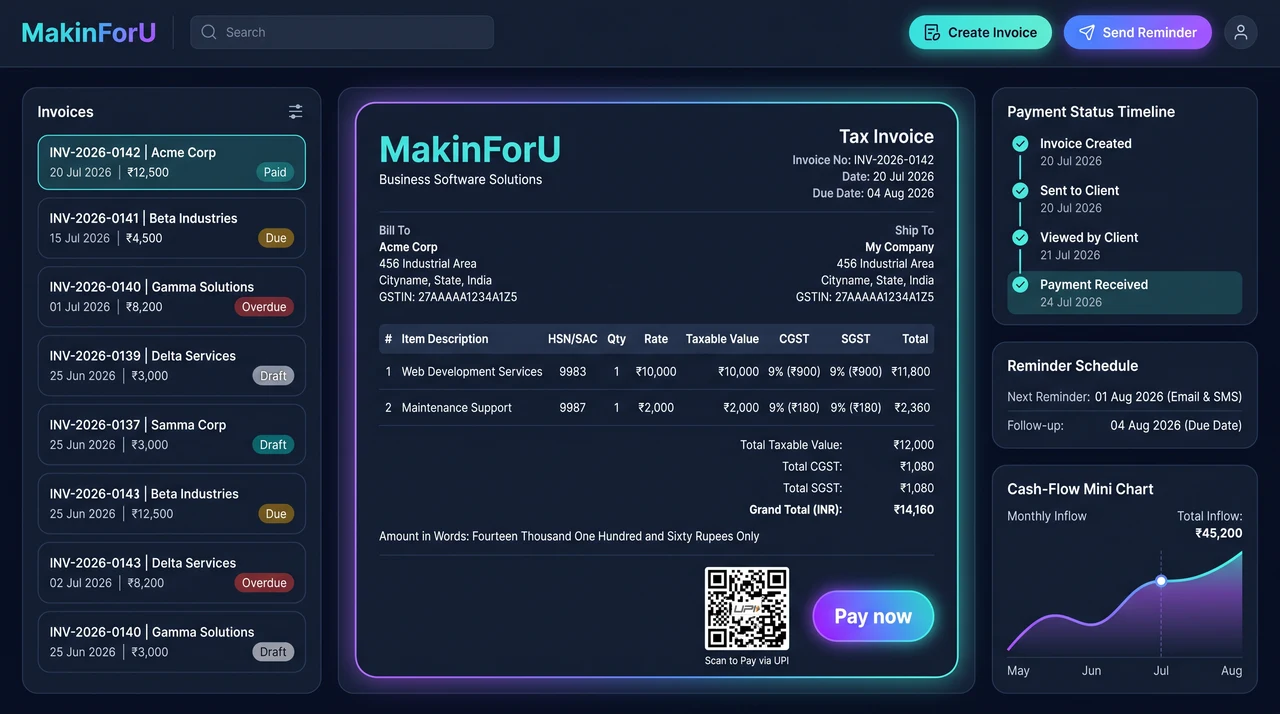
For businesses required to issue e-invoices, each B2B invoice has to be reported to the Invoice Registration Portal, which validates it and returns an IRN with a signed QR code. Done by hand, that means exporting invoice details and uploading them. With an API integration, your own software sends the invoice data, stores the IRN and QR code it gets back, and puts them on the invoice.
E-way bills come from the same data: once an invoice has an IRN, the e-way bill can be generated from it and updated later, for example when the vehicle changes. Access to these APIs usually runs through a GST Suvidha Provider (GSP); which route suits your setup is decided on the scope call.
What happens on the purchase side each month?
GSTR-2B is the statement of input tax credit built from what your suppliers have reported. The package reconciles it with your purchase records, so an invoice a supplier has not reported, or has reported with a different amount, shows up as a mismatch alert before you file, while there is still time to follow it up with the supplier.
GSTR-1 and GSTR-3B data is prepared from the same records, so the returns and the e-invoices start from one set of numbers. Every invoice, IRN and e-way bill is kept in an audit-ready archive you can go back to when a question comes up.
Do you need this if you already bill from TallyPrime?
Perhaps not for IRNs alone. TallyPrime has its own e-invoicing, so if every invoice is raised in Tally, that may already cover generation. This package is built for businesses whose invoices come from their own billing software, ERP or portal, and for teams who want 2B reconciliation and mismatch alerts on top. Tally is in the listed stack, so where your purchase records live, in Tally or elsewhere, is settled on the call.
If all you need is invoices from your app posted into Tally as vouchers, Tally Integration & Automation starts at ₹12,000 and is the smaller job. If the purchase-side problem is vendor invoices waiting for matching and approval, Accounts Payable Automation starts at ₹45,000.
What stays with you and your CA?
The package prepares the data for GSTR-1 and 3B and flags mismatches; submitting the returns on the portal is not a separate item in the feature list, so who files, your team or your CA, is settled on the scope call. Any fees charged by a GSP or other provider you connect through are separate from this package’s price. The API work covers the billing systems named in your proposal, and adding another source later is scoped on its own.
How it works
03- 0115-min callTell us what’s breaking. We ask the questions that change the price.
- 02Scope in writingA fixed quote and a written scope: what’s in, what isn’t.
- 03Build & reviewWorking software early, with review rounds on real screens.
- 04LaunchWe go live with you, train your team and hand over access.
- 05SupportFixes, changes and growth on a retainer, if you want one.
FAQ
04What does e-invoice API integration cost?
GST & E-Invoice Automation starts at ₹30,000 and is delivered within 30 days. It covers the sales side (IRNs, e-way bills, GSTR-1 and 3B data) and the purchase side (2B reconciliation and mismatch alerts), with an audit-ready archive of both. Your fixed price arrives in writing after a 15-minute scope call.
Do we need a GSP?
Access to the e-invoice and e-way bill APIs usually runs through a GST Suvidha Provider (GSP). Which route and provider fit your business, and whose credentials the integration uses, are settled on the scope call and written into the proposal. Any GSP charges are separate from this package’s price.
Will it file our GSTR-1 and GSTR-3B?
It prepares the data for both from your own invoices and purchase records, and flags mismatches with GSTR-2B before filing. Submitting the returns is not a separate item in the feature list, so who files them, your team or your CA, is settled on the scope call. Whoever files works from data prepared from the same records as your e-invoices.
What does the 2B reconciliation flag?
Differences between GSTR-2B and your purchase records: an invoice in 2B that is not in your books, a purchase you booked that the supplier has not reported, or one where the amount or tax differs. You see these as alerts before filing, while there is still time to follow up with the supplier.
Can e-way bills be updated after they are created?
Yes. E-way bill creation and updates are both in the package, so a change such as a new vehicle number can be made from your own software instead of the portal. What your dispatch team needs to update, and from which screen, is agreed on the scope call.
More in Tally & Finance
05Also see
0615 minutes.
One quote.
Tell us what you need. We reply on WhatsApp or email with a time, and a written quote after the call.
Re: GST & E-Invoice Automation