 MAKIN
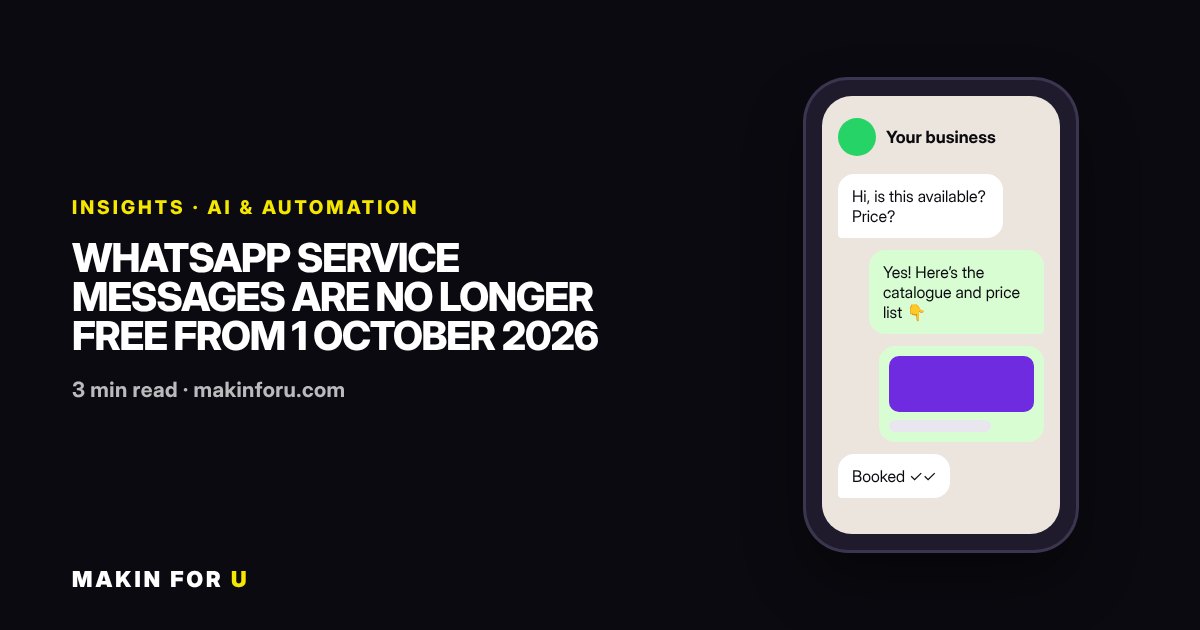
Since 1 October 2026, replies after the first 1,000 a month cost money on the WhatsApp Business Platform. Here is what it means for your bill and how to keep it low.
Free replies now have a monthly limit.
From 1 October 2026, service messages on the WhatsApp Business Platform, usually called the API, are chargeable. Each business phone number gets 1,000 free service messages a month, and every delivered reply after that is billed. Utility templates sent inside the customer service window are charged too. The free WhatsApp Business app on your phone is not affected.
What a service message is.
A service message is any free-form reply you send while the customer service window is open. The window opens when a customer messages you, resets each time they write again, and closes 24 hours after their last message. Only a customer message opens it: a message you send first does not. Messages customers send to you stay free.
What it costs.
Meta prices service messages at the utility rate for each country. For numbers in India, Meta’s rate card lists ₹0.115 per delivered service, utility or authentication message, and ₹0.8631 per marketing message. Your provider’s fee and GST come on top. A number that sends 3,500 replies in a month pays for 2,500 of them at the service rate.
Who should check their numbers now.
A busy support number that handles order status, complaints and delivery questions has probably crossed 1,000 replies already this month. A chatbot that splits one answer into five short messages now costs five times what one clear message does. Order confirmations sent while a chat is open are no longer free either.
Five ways to keep the bill low
Small changes to how a number replies make the biggest difference:
- Write fewer, fuller replies: one clear message instead of three short ones, and review bot flows for chatty steps
- Use buttons and lists so a customer picks an option and gets one answer, not a back-and-forth
- Send a short answer with a link to a help page instead of long multi-part replies
- When a chat starts from a Click to WhatsApp ad, messages in the free entry window are not charged, so answer fully then
- Watch replies per number each month: the 1,000 free messages reset monthly and do not carry over
Should you go back to the app?
Usually not. If your team needs a shared inbox, routing and CRM logging, the API still costs far less than missed leads. The change is a reason to tidy your flows, not to drop automation. Our guide on the app versus the API covers where the line falls.
Do not want to pay a monthly subscription on top?
Meta’s per-message charges apply to everyone on the API. What you can avoid is a monthly platform subscription stacked on top of them. We set up your WhatsApp inbox, bot and CRM link as a one-time build that you own, so you pay Meta’s message charges and nothing recurring to us. Contact MakinForU for a fixed, written quote.
What it costs with us
Our WhatsApp & Support Automation package starts at ₹12,000 and covers the API setup, routing with human hand-off, lead capture into your CRM and template management. To estimate Meta’s charges for your volume, use the WhatsApp API cost calculator or read the WhatsApp API pricing guide.