 MAKIN
Five fields, and why these five.
Stage, expected close date, value, next step, and owner. Everything else is commentary. With these five filled honestly you can forecast, spot stalls and hold a pipeline review. Without them, no amount of extra fields rescues the picture.
Next step is the one people skip.
It is also the one that predicts a stalled deal. A deal with no next step is not slow, it is over — the rep just has not admitted it yet. Making that field required surfaces dead pipeline weeks earlier than a stage review does.
Dates should mean something.
If the close date is whatever keeps the deal out of an overdue report, the forecast is fiction. Tie it to an event the customer has acknowledged — a board date, a contract expiry — and it starts predicting rather than describing hope.
Review the fields, not just the deals.
Once a quarter, check which fields were actually filled. Anything consistently empty is either not needed or not understood, and both are fixed by removing it rather than by another reminder.
Stage: defined by what the buyer has done
A stage name means little until it has an exit rule. If ‘Proposal’ means ‘we plan to send one’ to one rep and ‘the buyer has read it’ to another, the stage report is averaging two different things. Define every stage by something the customer has done that you can check, rather than something your team intends to do.
Keep the list short enough that nobody hesitates between two stages, and merge any pair that keeps getting confused in review. If a deal can sit in a stage for reasons unrelated to the buyer, the stage is measuring your process, not theirs. An example set:
- Qualified: the buyer has confirmed the problem, who decides and a rough timeframe
- Discovery complete: the person who approves the spend has confirmed the requirement
- Proposal: the decision-maker, not only your contact, has acknowledged a priced proposal
- Negotiation: the buyer has responded to price or terms in writing
- Closed: a signed order or a clear no, with the reason recorded
Value: one definition, written next to the field
Value breaks forecasts quietly when reps fill it in differently. Decide once what the number represents, whether first invoice, first-year contract or total contract, and put that definition in the field’s help text. Decide whether it includes tax. A total built from mixed definitions is a sum of unlike things.
Stop two habits early. Placeholder values, entered only to get past a required field, should be blocked or visibly flagged. And the value should change when the quote changes: a deal priced after discovery that still shows the guess from the first call is misstating the forecast by an amount nobody knows.
Owner: one name per deal
A deal with two owners effectively has none. Shared ownership feels collaborative, but in review each person can assume the other updated the next step. Assign one owner, list others as contributors if your CRM allows it, and make changing the owner a deliberate, recorded action.
Decide in advance what happens when someone leaves or changes territory. Their open deals should move to a named queue with a person responsible for reassigning them, not stay under a deactivated user where they can drop out of filtered reports.
What a next step that counts looks like
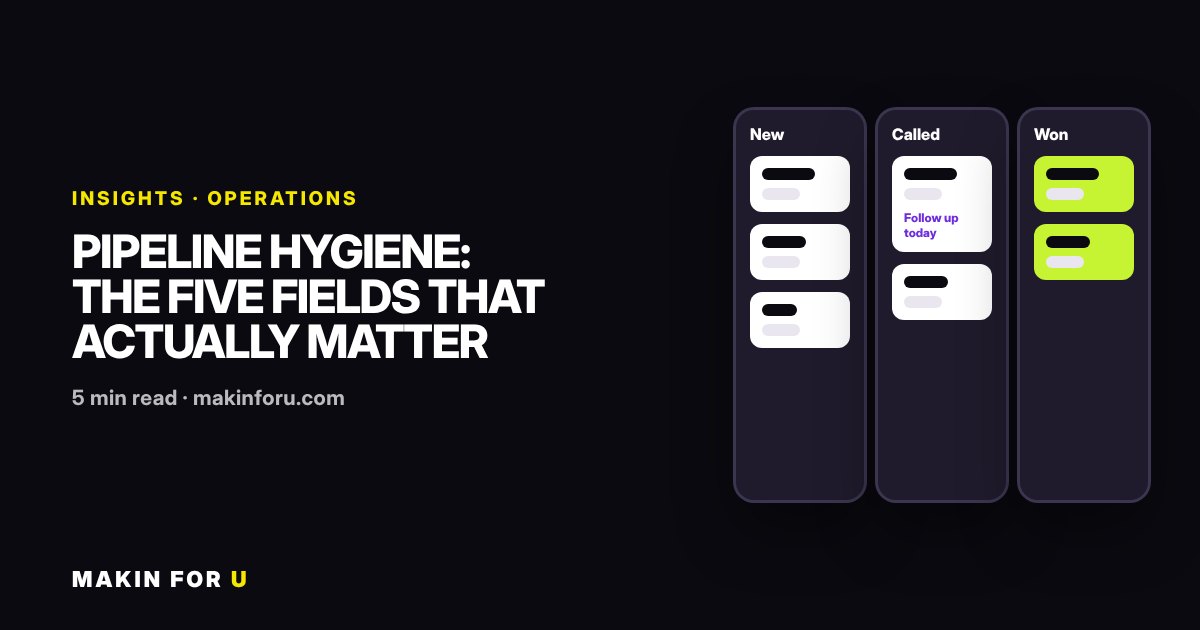
A vague next step is almost as bad as a missing one, because it looks filled. ‘Follow up’ is not a next step; it is a reminder to think of one. A useful next step names an action, the person on the customer’s side and a date, so anyone reading the record knows what should happen and when.
Hold the next step as a dated task, not a note, and the CRM can do the chasing: any next step dated in the past marks a deal that needs attention today. Shown as a daily list for each owner, that rule does the work of the reminders a manager would otherwise send. Some rewrites:
- Weak: follow up. Better: call the finance head on Thursday to confirm budget sign-off
- Weak: send proposal. Better: send the phased option to the operations lead before their review meeting
- Weak: waiting on client. Better: client to share the vendor list; chase on Monday if it has not arrived
- Weak: demo. Better: demo to the plant manager and accounts together, on an agreed date
Requiring fields without losing adoption
Every required field is friction, and friction is paid for in deals that never get logged. The answer is to require each field at the moment it becomes knowable, not when the record is created. A new lead needs an owner and a next step. Value becomes required on entering the proposal stage. Close date becomes required at the stage where the buyer names the event behind it.
- Enforce value and close date on stage change, not on record creation
- Use dropdowns for stage and loss reason; keep open text for the next step
- Put the five fields at the top of the mobile view
- Pre-fill the owner from whoever creates the record
- Leave everything else optional until the quarterly field review shows it is used
A weekly review built on the five fields
With the five fields in place, the weekly pipeline review becomes a set of filtered lists rather than a round of verbal updates. Work through the same lists in the same order each week and spend time only on the deals that appear. A deal that appears on none of them does not need discussing that week:
- Open deals with no next step, or a next-step date already passed
- Deals whose close date has passed without a change of stage
- Deals whose close date has moved more than once, and what moved it
- Deals sitting in one stage longer than is normal for that stage
- High-value deals with a vague next step
Starting from a cluttered CRM
Trimming an overgrown CRM in place can be slow, because every field has a defender. It is often cleaner to export, map the five fields, archive the rest and deduplicate before anyone logs a new deal. CRM Migration & Cleanup, from ₹9,000, covers the mapping and deduplication when you are also changing platforms. If the pipeline still lives in spreadsheets, Sales CRM Starter, from ₹18,000, starts with pipeline and stage design, where the five fields get set.